
The Financial Sector Legislative Reforms Commission, chaired by Justice B N Srikrishna, has suggested a non-sectoral, principle-based approach to revamp the existing framework.
Lack of decisiveness and courage to deal with PSBs may turn out be the biggest impediment to the Modi government's economic initiatives, says Debashis Basu.

'Modi has not lacked courage in the political sphere. It is time he showed it in the economic sphere as well.' 'To do this, he needs to shed the simple-minded nostrums about economic growth and swadeshi that he learnt in the Sangh Parivar,' suggests Virendra Kapoor.

The Indian economy requires a Rs 3 lakh crore fiscal stimulus, including cash transfer to households through Jan Dhan accounts to spur economic growth amid the pandemic, industry chamber CII said on Thursday and pitched for appointment of a 'Vaccine Czar' for speedy vaccination coverage. CII president T V Narendran also said the chamber expects GDP to grow at 9.5 per cent in 2021-22 as the strong growth in the second half of the fiscal year will be supported by robust external demand and large-scale coverage of vaccination, allowing resumption of economic activity. He also advocated for appointment of a "Vaccine Czar" for speedy vaccination coverage.

'This is clearly a much stronger government, a much strong Prime Minister's Office and a much more disciplined approach. There is an improvement of the work culture in the government -- people don't play golf in the mornings anymore. There is a huge attempt going on to making business easier,' says Rakesh Mohan, executive director at the IMF.

RBI Governor Raghuram Rajan had set up a committee to review the monetary policy framework.

Now SLR has come down to 23 per cent, CRR is 4.5 per cent.

The size of the hole in today's banking crisis appears to be roughly 10 per cent of GDP.
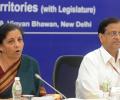
Subhash Chandra Garg, the former finance secretary who was shunted out of the finance ministry within three weeks of Modi-2.0 government's first budget last year, on Saturday alleged that new Finance Minister Nirmala Sitharaman got him transferred out.

BoB now has over 9,500 branches, 13,400 ATMs, 85,000 employees to serve 12 crore customers.

Lauding the pro-reforms approach adopted by Reserve Bank of India Governor Raghuram Rajan, industry body Confederation of Indian Industry on Thursday expressed the hope that the central bank would shift towards an expansionary monetary policy by cutting interest rates to stimulate growth.
.jpg)
2014 made a lot of promises; can the new year deliver?

India's economic growth is likely to reach pre-COVID-19 levels by the end of the 2021-22 fiscal as the GDP contraction in this financial year is expected to be less than 8 per cent, Niti Aayog vice chairman Rajiv Kumar said on Sunday. The Reserve Bank of India (RBI) has also revised its forecast of economic growth for the current fiscal year (2020-21) to (-)7.5 per cent as against its earlier forecast of (-)9.5 per cent.

The rate hike in the future is set to be 'calibrated and cautious'.

India would be a major beneficiary of softer oil prices among the G20 economies as the country is a major crude importer.
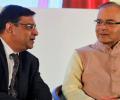
The lack of an informal communication channel is what should bother the government and the RBI, if they want to eliminate the undesirable outcomes of the current tension between the two, says A K Bhattacharya.

'We still need a certain number of large public sector banks for financial inclusion and stability purposes.'

'The banks cannot pass on the hike in premiums to its customers, according to the norms. The premium won't go up substantially in any case and may be hiked to 12-13 paise (per deposit of Rs 100 a year),' Finance Secretary Rajiv Kumar said.

'The quick fixes have failed; there is now no alternative to deeper reforms,' says Ajay Shah.

Housing Development Finance Corp (HDFC) chairman Deepak Parekh on Tuesday said that while the country's macroeconomic fundamentals remain strong and the recovery is in progress, the unpredictability of coronavirus will remain a key challenge. Owing to the second wave, the Indian economy is likely to mirror a similar trend seen in FY21, where the first half of the financial year is weaker and the second half is significantly stronger, he said. "I remain confident that India's macroeconomic fundamentals are strong. Recovery is underway," Parekh said while addressing the 44th annual general meeting of HDFC Ltd. He said, the country's forex reserves and foreign direct investment inflows have scaled record highs, the capital markets are also buoyant and agriculture growth is expected to remain strong with food grain production estimated at over 305 million tonnes.
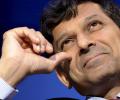
'The RBI risks becoming dangerously weakened, as successive governments and finance ministers have misunderstood its role'.

The banking sector is set to move at a fast pace from hereon.

Calling out the high real interest rates -- the differential between the policy rate and headline inflation -- as an impediment to investment, the SBI report said the RBI can cut rates by 0.35-0.50 per cent at its next policy announcement.

The US Fed will decide if it should raise interest rates from near-zero levels first time in a decade.

Subramanian recommended five ways of financing additional expenditure over a period of one year, including cutting expenditure and borrowing directly from the RBI or monetising debt.

It is also considering to hike FDI cap for public sector from 20 per cent to 49 per cent

Several leading industrialists, including Reliance Industries CMD Mukesh Ambani, Vedanta Resources Limited executive chairman Anil Agarwal, chairman emeritus of Tata Sons Ratan Tata, Mahindra Group chairman Anand Mahindra, Paytm Founder and CEO Vijay Shekhar Sharma, Welspun Group chairman and Assocham president B K Goenka, attended the swearing-in ceremony.

Fitch said COVID-19 is still in India and it is very likely that the government will have to spend a bit more on fiscal measures to support the economy.

Rajan, a professor at the University of Chicago, said if the money raised by the government was not spent, it could result in inflationary pressures, pushing up real interest rates. The problem could get aggravated if foreign capital flows rose, said Rajan, who was in Mumbai to deliver a lecture.
The rupee's travails allow the RBI's incoming governor to renegotiate the objectives of monetary policy.

Former Reserve Bank of India (RBI) Governor Raghuram Rajan says the government should take advantage of the peaks in the Indian equity markets right now and sell stakes in PSUs while prioritising spending to get the economy back on track. The upcoming Budget for the fiscal year beginning April 1 should look to provide "relief to the poorer households and small and medium enterprises," he said. And then move on to getting the economy back on track.

Terming the 23.9 per cent fall in economic growth in the June quarter alarming, former Reserve Bank Governor Raghuram Rajan has said bureaucracy should come out of complacency and take meaningful action. The current crisis requires a more thoughtful and active government, he said, adding, "Unfortunately, after an initial burst of activity, it seems to have retreated into a shell."

'In the real economy, the scars of the pandemic will continue to define 2021.' 'It is still hard to tell the effect on unemployment, migrant workers, poverty, and the informal sector of the lockdown and of the pandemic,' observes Mihir S Sharma.

For development finance institution to succeed now, the government must stand like a rock behind it and be patient.

'We first need to acknowledge the truth.' 'We are trying to diminish the problem and say, everything is okay and green shoots are emerging.' 'Imagine you are a doctor and not getting accurate medical reports, how do you diagnose and treat the illness?' 'We are not dealing with a terminal illness here, we are dealing with BP and cholesterol, which are imminently curable.'

The finance ministry on Tuesday cited "green shoots" of recovery in agriculture, manufacturing and services sectors, and said the prompt policy measures taken by the government and RBI have helped reinvigorate the economy with minimal damage. Stating that the agricultural sector remains the foundation of the Indian economy, the ministry said that a normal monsoon, as has been forecast, should support the rebooting of economy.

EY said out of the nearly Rs 21 lakh crore package, Rs 8.01 lakh crore is on account of liquidity enhancing measures taken by the RBI since February.
The growth rate was much higher a year ago at 8.7%.
China's savings rate is above 40 percent, while India's is in the range of 20 to 30 percent.

RBI Governor Raghuram Rajan on Tuesday kept the repo rate unchanged 6.50 per cent.
 © 2026 Rediff.com - Advertise with us - Disclaimer - Privacy Policy - Sitemap - Feedback - About us - Terms of use - Grievances